
Reviewed · AUDIO TOURS
Big Cypress National Preserve Self Guided Driving Audio Tour
Big Cypress is best understood from the driver’s seat. This 42-plus-mile route carries you through cypress swamp, hardwood hammocks, wildlife-rich waterways, and roads with stories behind them. The audio also gives useful context on the Miccosukee, Seminole, and Calusa peoples, plus the surprising plan to build a giant airport here.
I like the freedom to stop for five minutes or an hour, and I like that one $16.99 purchase covers everyone in a car of up to four people. The main caution is road quality: parts of Loop Road can be rough and potholed, and the Gator Hook Trail needs wet-weather footwear and a willingness to wade.
In This Review
- Key points to know before you go
- What this Big Cypress audio tour is really like
- Starting near US Highway 41
- Miccosukee Indian Village and Native culture
- Tree Snail Hammock Trail: a tiny creature, short walk
- H.P. Williams Roadside Park and its wildlife
- Loop Road and the story behind the pavement
- County Road 94 and the airport that never came
- Gator Hook Trail: know what you are getting into
- Kirby Storter Roadside Park and the mile-long boardwalk
- The preserve entrance and Buffalo Tiger’s boat shop
- Ochopee Post Office on Tamiami Trail
- Nathaniel P. Reed Visitor Center
- Big Cypress Bend Boardwalk and old-growth cypress
- Price, app setup, and the real value
- Who should book this self-guided drive
- Should you book the Big Cypress audio tour?
- FAQ
- How much does the Big Cypress audio tour cost?
- How long does the driving tour take?
- Is the tour guided in person?
- What language is available?
- Does the tour include admission to attractions?
- Does the audio work without cell service?
- How does the audio begin?
- Is the tour valid for another trip?
- Do I need special shoes for Gator Hook Trail?
Key points to know before you go
- A 27-story audio route: The app plays location-based commentary as you drive from stop to stop.
- Wildlife without a fixed schedule: H.P. Williams Roadside Park is a strong place to look for alligators, turtles, snakes, herons, egrets, and hawks.
- Useful cultural context: The route explains the Miccosukee presence in South Florida and the Seminole connection to the Creek people of Georgia.
- Two excellent boardwalk stops: Kirby Storter Roadside Park and Big Cypress Bend Boardwalk offer easy walking through cypress and hardwood forest.
- Good value for a car: At $16.99 per group, the price is much lower than a private guide for one to four people.
- Prepare for uneven conditions: Gator Hook Trail can become a wet, knee-deep walk, while Loop Road may be rough for low-clearance vehicles.
What this Big Cypress audio tour is really like
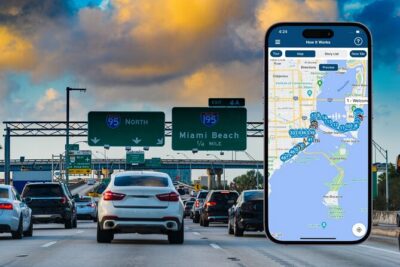
This is not a guided bus ride or a scheduled nature excursion. You drive your own vehicle, open the Action’s Tour Guide app, and follow audio cues that begin when you reach each location.
That format works well in Big Cypress. The preserve is spread out, and the best parts are separated by long stretches of road. Instead of treating the drive as empty time, the narration explains what you are seeing and why the route matters.
The published timing varies. One description gives the route as more than 42 miles and about two to three hours, while another refers to a 48-plus-mile version taking three to five hours. Your actual time depends on which starting point and direction you select, how long you spend on trails, and how often you pause for wildlife.
I would plan at least half a day if you want to walk the boardwalks and make side stops. You can also split the drive across more than one day because the purchase now provides lifetime access with no expiry. That is a useful change for anyone making several trips through South Florida.
A few more Miami bookings worth a look
- Miami: Everglades National Park Airboat Tour & Wildlife Show
★ 4.5 · 7,296 reviews - Half-day Everglades National Park Tour and 1-Hour Air Boat Ride
★ 5.0 · 811 reviews - Everglades National Park Biologist Led Adventure: Cruise, Hike + Airboat
★ 5.0 · 685 reviews
Starting near US Highway 41
The opening stretch introduces the people who lived in South Florida long before modern highways crossed the swamp. The audio explains that the Miccosukee were not the only tribe connected to this region and points to the Calusa as another powerful South Florida people.
You also hear about the Seminole, descendants of the Creek tribe in Georgia. During the Indian Wars of the 1800s, about 100 Seminole people fled into the Everglades and hid to avoid capture. That detail gives the drive a human story from the start, rather than treating the swamp as scenery alone.
The route is easy to follow because the app uses your location and tells you when to continue. Still, download the tour before you leave strong Wi-Fi or cellular service. Once the content is stored on your phone, the audio and maps work offline, which matters in an area where your signal may not be dependable.
Miccosukee Indian Village and Native culture
The Miccosukee Indian Village offers an optional stop where you can see Native arts and crafts and visit a museum about Miccosukee history. Admission to the audio tour does not include entry to the village or any other attraction, so treat this as a possible side visit rather than part of the paid package.
I like that the route gives you a reason to connect the village with the surrounding land. The Miccosukee story is not presented as a footnote. It is tied to the waterways, forests, and refuge of the Everglades.
You should allow extra time here if you want to browse the arts and crafts or spend time in the museum. The audio portion itself lists about ten minutes, but that is a suggested stop length, not a limit.
Tree Snail Hammock Trail: a tiny creature, short walk
The Tree Snail Hammock Trail is a quarter-mile loop through hardwood forest. If you only want to stretch your legs, the walk can take around five minutes. The reason to linger is the chance to spot the tree snail, an elusive creature that gives this brief trail its character.
This is a good example of the tour’s flexible design. You can hear the story, park, and decide how much effort the stop deserves. It is not necessary to turn every stop into a serious hike.
Use care when looking for wildlife. The point is observation, not handling or disturbing anything. The route gives you a short forest walk in a place where the small details can be as interesting as the larger alligators later on.
Something completely different for your Miami days:
- Little Havana Food and Walking Tour in Miami
★ 5.0 · 8,882 reviews - From Miami: Everglades Airboat, Wildlife Show & Bus Transfer
★ 4.2 · 8,622 reviews - Miami: Biscayne Bay Millionaire’s Homes Sightseeing Cruise
★ 4.5 · 7,348 reviews - Water Taxi All Day hop-on hop-off Venice of America Boat Tour
★ 4.5 · 3,932 reviews
H.P. Williams Roadside Park and its wildlife
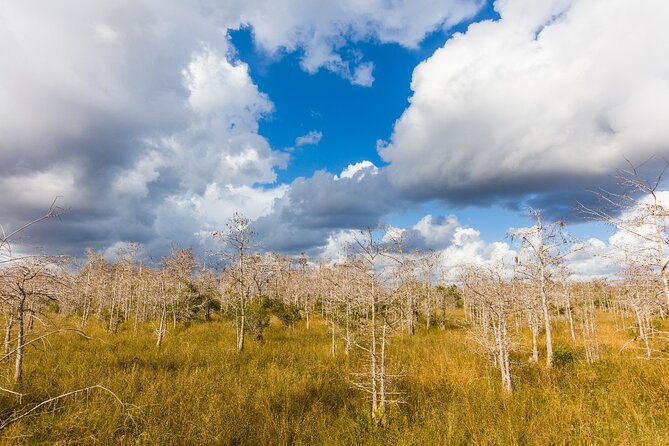
H.P. Williams Roadside Park is one of the most practical stops on the route because it offers a boardwalk along a waterway. The setting is suited to wildlife watching, with alligators and turtles often associated with the water, and the possibility of snakes nearby.
Look up as well as down. Herons and egrets may be wading along the edge, while hawks can perch in the trees above. You get a compact view of the preserve’s wet and wooded sides without committing to a long walk.
This is a place where patience helps. Wildlife is never guaranteed at a precise moment, and the audio cannot control what appears. Give yourself more than the listed ten minutes if you want to watch quietly and take photographs.
Loop Road and the story behind the pavement
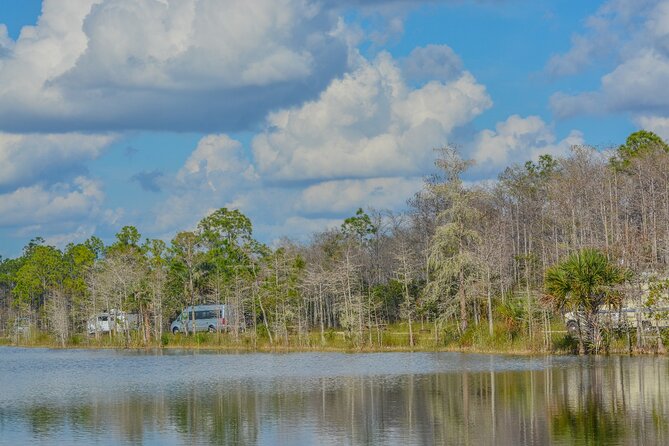
Loop Road may look like a simple route through the swamp, but the narration explains why it exists. In 1915, Miami businessman James Jaudon imagined a highway across South Florida that would make it easier to move goods through the swamp.
The historical angle adds value to what might otherwise feel like a slow road. You are not just driving through trees and water. You are following an old idea about transportation, development, and the difficulty of building across wet ground.
Here is the practical warning: road conditions can be poor. One especially negative experience focused on potholes and a rough drive, and that criticism is worth taking seriously. Drive at a safe speed, follow posted limits, and do not assume you need to rush through damaged sections. A low-clearance car may be less comfortable here than a sturdier vehicle.
County Road 94 and the airport that never came
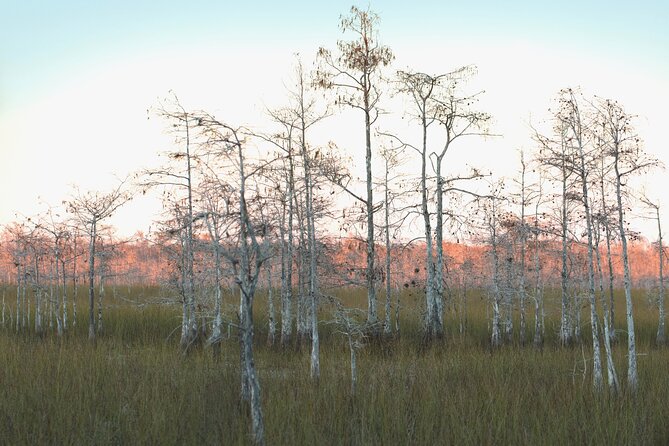
Big Cypress became a national preserve partly because it escaped a major development plan. When Everglades National Park was created in the 1940s, the federal government could not buy all of the privately owned land in this area. As a result, the Big Cypress tract remained open to other plans.
In the 1960s, the government proposed building the Big Cypress Jetport here. It was intended to become the largest airport in the world. The idea sounds startling while you are surrounded by swamp, but it shows how close this region came to being reshaped on a massive scale.
This is one of the strongest parts of the audio because it helps you understand why preservation happened when it did. Without that context, a quiet road can seem like an ordinary back-country drive. With it, the road becomes part of a much larger argument about South Florida’s future.
Gator Hook Trail: know what you are getting into
Gator Hook Trail is the most demanding stop on the route. The five-mile round trip begins on dry land, then moves into ankle-deep water and can reach knee depth. For shorter walkers, the water may come as high as the hips.
That description should guide your decision. This is not a casual stroll in sandals. Wear shoes that can get wet, and expect muddy or uneven conditions. A useful preparation note for this tour is to bring footwear suited to wading, something that was not obvious to every person who tried the route.
You can skip this trail without losing the main value of the tour. The audio gives you the option to learn about it, then continue to easier stops. If you want a real swamp walk and have suitable clothing, it offers a more physical look at Big Cypress than the boardwalks do.
Kirby Storter Roadside Park and the mile-long boardwalk
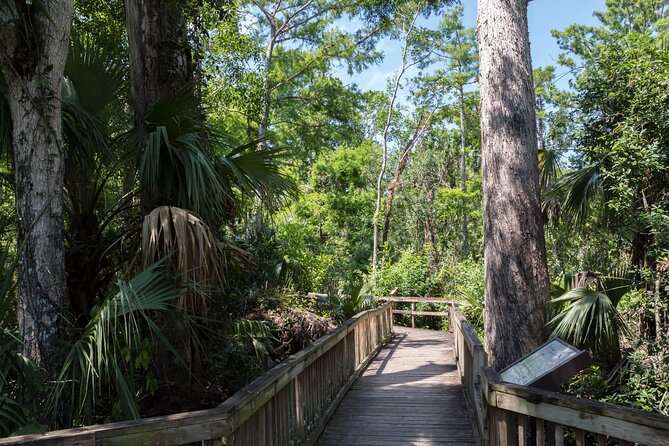
Kirby Storter Roadside Park is one of the easiest places to enjoy the preserve on foot. Its mile-long boardwalk passes through hardwood and cypress trees, with shade and a strong sense of being surrounded by swamp forest.
The boardwalk is a good fit for you if you want scenery without wet hiking. It also gives you time to slow down after the road sections. Ten minutes is enough for a quick look, but the full mile deserves longer if you want photographs or a quiet walk.
I would make this one of the priority stops. It gives you a clear, accessible view of the plant life and water conditions that define Big Cypress, and it does so with less physical risk than Gator Hook Trail.
The preserve entrance and Buffalo Tiger’s boat shop
The listed starting point for the preserve portion is 29701 Southwest 8th Street in Miami, near Buffalo Tiger’s boat shop. You should use the starting location shown in the app because the route information describes more than one version, including different mileage and timing.
No guide meets you there. This is a private activity for your own group, and you begin by opening the app at the first story point. If more than one tour version appears, select the one that matches your planned starting point and direction.
That small setup step matters. The audio is designed to trigger automatically by GPS, but it works best when you are on the intended route and moving at the suggested speed. If you begin somewhere else or choose the wrong direction, the timing may feel confusing.
Ochopee Post Office on Tamiami Trail
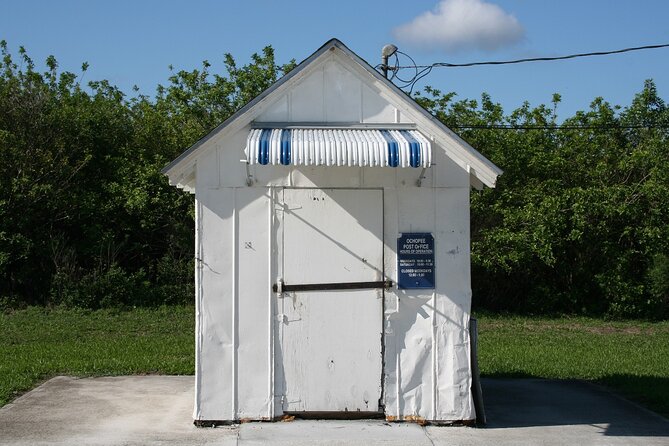
At 38000 Tamiami Trail East, watch for a small white building: the Ochopee Post Office, described as the smallest post office in North America. You can stop for a look, and the post office is usually willing to postmark mail.
This is a charming, simple souvenir. Instead of buying another mass-produced item, you can send a postcard with a postmark tied to a very specific place. The stop takes little time, so it fits easily into a self-guided day.
The value here is not size or grand architecture. It is the odd local detail that makes a drive memorable. The audio points it out so you do not pass it by.
Nathaniel P. Reed Visitor Center
The Nathaniel P. Reed Visitor Center marks the end of the main route described in the app. It offers standard visitor amenities and displays some paintings by Everglades artist Sam Vinikoff.
The building itself is also worth noting. It was designed with energy conservation in mind, making it a useful stop for understanding how a visitor facility can respond to the climate and setting.
If you want more time with the preserve, this is a sensible place to pause before continuing to Big Cypress Bend Boardwalk. The audio lists the center as the tour’s end, but the boardwalk is about ten miles away and is included in the wider route information.
Big Cypress Bend Boardwalk and old-growth cypress
Big Cypress Bend Boardwalk is a half-mile route through an old-growth cypress grove. It offers the kind of classic Big Cypress scenery many people hope to see: tall trees, green growth, shade, and a raised path through wet ground.
I would choose this stop if you have limited time and want a concentrated taste of the preserve. It is shorter than Kirby Storter’s boardwalk, but the cypress setting gives it a different feel.
The two boardwalks work well together. Kirby Storter offers a longer walk through hardwood and cypress forest, while Big Cypress Bend gives you a shorter route through an older cypress grove. If you have the time, do both rather than trying to pick only one.
Price, app setup, and the real value
The $16.99 price is charged per group of up to four people, not per person. For a full car, that is excellent value, especially compared with hiring a private guide or joining a fixed group tour.
You are paying for narration, directions, offline maps, and the ability to repeat the experience. You are not paying for attraction admission, food, parking reservations, or a person in the car. Those costs and arrangements remain your responsibility.
After booking, look for an email and text with setup instructions and a password. Search for audio tour if the message is hard to find. Download the separate Action’s Tour Guide app before arriving, enter the password, and connect your phone to the vehicle by Bluetooth, USB, or AUX.
The app supports Apple CarPlay. Android Auto support is still described as coming soon, so an Android user should be prepared to use the phone itself or another connection method. An iPhone running iOS 15 or later, an Android device running version 9 or later, or an iPad with GPS and cellular service is recommended.
Who should book this self-guided drive
I would choose this tour if you enjoy setting your own schedule, want background stories during a long drive, or are traveling with family and do not want to match a guide’s timetable. It also suits repeat visitors because you can return to sections, skip stops, or use the tour again on another trip.
It is less suitable if you expect a polished road, guaranteed wildlife sightings, or hands-on guiding. The route can include rough pavement, and the most adventurous trail requires wet hiking. You also need to be comfortable handling your own navigation and phone setup.
The tour is offered in English only. Most people can participate, but Gator Hook Trail is a separate physical challenge and should not be treated as an easy stop.
Cancellation is free up to 24 hours before the scheduled start time. Inside that window, the cost is not refunded. The activity is available daily from 9:00 a.m. to 5:00 p.m. during the stated operating period, and the app itself can be paused and resumed across multiple days.
Should you book the Big Cypress audio tour?
Book it if you want an affordable, flexible way to connect the roads, wildlife stops, Native history, boardwalks, and preservation story of Big Cypress. The strongest features are the location-triggered narration, lifetime access, and per-car pricing.
Skip it if rough roads would ruin your day or if you want a live guide to manage every detail. For the best experience, download the app early, bring wet-weather shoes for Gator Hook Trail, allow more than the shortest stated time, and treat the route as a relaxed half-day outing rather than a race from stop to stop.
FAQ
How much does the Big Cypress audio tour cost?
The tour costs $16.99 per group, with up to four people included in one vehicle.
How long does the driving tour take?
The route is described as more than 42 miles and about two to three hours, while a longer version is described as more than 48 miles and three to five hours. Your timing depends on stops, walks, and breaks.
Is the tour guided in person?
No. This is a private, self-guided activity. No guide meets you at the starting point.
What language is available?
The tour is offered in English.
Does the tour include admission to attractions?
No. Attraction entry tickets, passes, and reservations are not included.
Does the audio work without cell service?
Yes. Download the tour while you have strong Wi-Fi or cellular service. After downloading, the audio and maps work offline.
How does the audio begin?
Open the Action’s Tour Guide app at the starting point. Enter the first story location, and the audio should begin automatically. Further stories play as you reach the next locations.
Is the tour valid for another trip?
Yes. The current information states that access is lifetime, with no expiry. You can use it on multiple trips and pause or resume it as needed.
Do I need special shoes for Gator Hook Trail?
Yes, you should bring shoes that can get wet. The trail begins on dry ground but can involve ankle-, knee-, or hip-deep water depending on conditions and your height.
More Audio Tours in Miami
- Self-Guided Audio Tour in Florida Keys
★ 4.5 · 84 reviews - Everglades National Park: Self Guided Driving Audio Tour
★ 4.5 · 58 reviews - Ultimate Florida Self Guided Driving & Walking Audio Tour Bundle
★ 4.0 · 13 reviews - Fort Lauderdale Riverwalk Self-guided Audio Walking Tour
★ 4.0 · 10 reviews
Fresh reviews out of Miami
- Miami’s Best Views: Private Boat Tour★ 5.0 · 3 reviews
- Jetcar Experiences★ 5.0 · 3 reviews
- Palm Beach Tour from Miami – Flagler’s Museum + Hotel Breakers★ 5.0 · 3 reviews
- Miami: Private Yacht Rental Tour with Dolphins and Snorkel★ 4.9 · 3 reviews
- Hollywood Meets Miami Beach Movie and Tasting Tour★ 5.0 · 3 reviews
- Little Havana French Gourmet Guided Tour★ 5.0 · 3 reviews
- Miami: Everglades National Park Hiking and Kayaking Day Trip★ 5.0 · 3 reviews
- Miami: 30-Minute Private Helicopter Tour with Champagne★ 5.0 · 3 reviews
Audio Tours, compared.
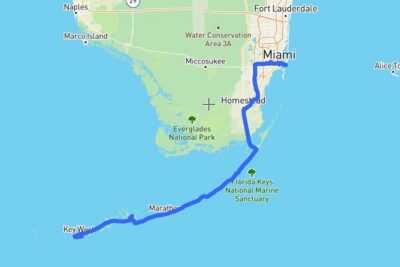

Ultimate Florida Self Guided Driving & Walking Audio Tour Bundle
Read our review →
Fort Lauderdale Riverwalk Self-guided Audio Walking Tour
Read our review →

Browse the lists this tour appears in